 StartEase
Jury duty leave policy: pay, the law, and how to set it up
What jury duty leave is, what federal law says about paying for it (including for exempt salaried staff), and how to set up a jury duty policy in StartEase block by block.
What is a jury duty leave policy?
Jury duty leave covers the time an employee is summoned to serve on a jury, or to attend for jury selection.
Why companies offer it
- Jury service is a civic duty employees cannot refuse.
- Some states require employers to pay for it.
- Recording it keeps an exact record of each absence.
What the law says, in short
The U.S. Department of Labor says the FLSA does not require payment for time not worked, including jury duty, and that some state laws require employers to pay employees who serve. For exempt salaried employees, federal rules say an employer cannot make deductions from pay for absences caused by jury duty, but can offset jury fees the employee receives for that week.
How to set up a jury duty policy in StartEase
- Open Time › Time off and scroll to Policies.
- Under Add a policy, choose Jury duty, then select Add policy.
- Fill in each block below. The example is a sample "Jury duty" policy: your company chooses its own numbers.
- In Review and turn on, read the summary sentence and select Turn on this policy.
This example is Unlimited, so StartEase keeps no balance and the Caps block does not appear.
Basics
The name, the kind of leave, whether it is paid, and what employees read about it. More on this block.
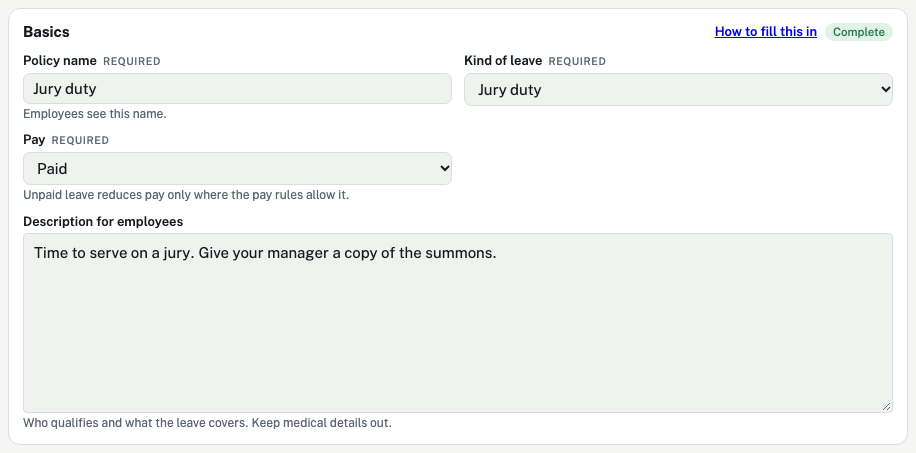
| Box | What it means | In this example |
|---|---|---|
| Policy name | The name employees see when they ask for time off and on their balances. Required. | "Jury duty" |
| Kind of leave | What the leave is for. It picks the help link and the extra checks. It does not change how the balance is counted. Required.
| Jury duty |
| Pay | Whether the hours are paid. Required.
| Paid Exempt salaried staff must not lose salary for jury duty; paying everyone is simplest. |
| Description for employees | Up to 600 characters on My time off: who qualifies and what the leave covers. Keep medical details out. | "Time to serve on a jury. Give your manager a copy of the summons." |
Earning
How the balance grows. Nothing is earned until a payroll is approved. More on this block.

| Box | What it means | In this example |
|---|---|---|
| How it is earned | How the balance grows. Required.
| Unlimited (no balance kept) Service lasts as long as the court needs, so no balance is kept. |
Rules
Waiting periods, negative balances, a yearly use limit and payout at exit. More on this block.
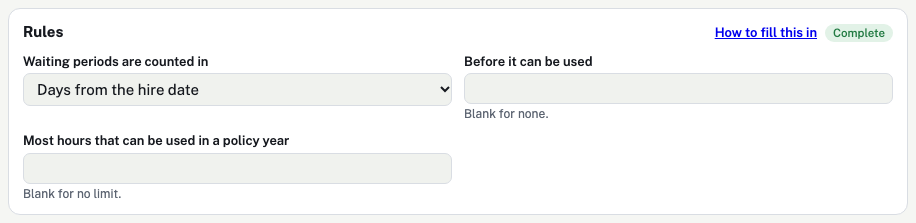
| Box | What it means | In this example |
|---|---|---|
| Waiting periods are counted in | The unit for the two waiting periods below.
| Days from the hire date |
| Before it can be used | Leave can be earned but not taken before this. Blank for none. | Blank |
| Most hours that can be used in a policy year | A yearly limit on hours taken. Blank for no limit. | Blank |
Requests
How employee requests are handled. More on this block.
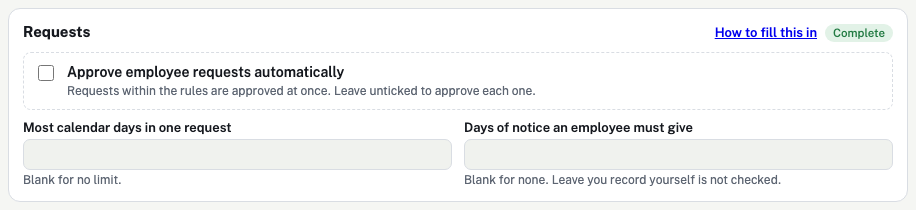
| Box | What it means | In this example |
|---|---|---|
| Approve employee requests automatically | Ticked: a request that follows the rules is approved at once. Unticked: the Employer or payroll team approves each one. | Unticked |
| Most calendar days in one request | For example 10. Blank for no limit. | Blank |
| Days of notice an employee must give | For example 3 means the first day must be at least 3 days away. Leave you record yourself is not checked. Blank for none. | Blank |
Employees
Who the policy covers and where each balance starts. More on this block.
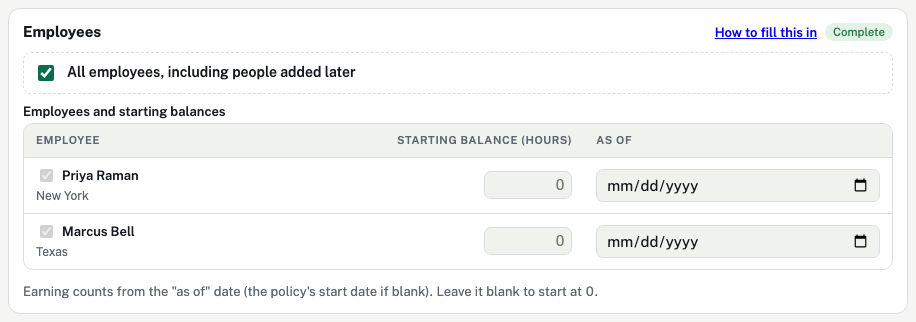
| Box | What it means | In this example |
|---|---|---|
| All employees, including people added later | Ticked: everyone is covered, now and later. Unticked: tick each employee in the table. | Ticked |
| Starting balance (hours) | Hours the employee already has, for example from your old system. Blank starts at 0. | Not used: no balance is kept |
| As of | The date that starting balance is correct. Earning counts from this date, or from the policy's start date if blank. | Blank |
Review and turn on
The last check before employees can use the policy. More on this block.
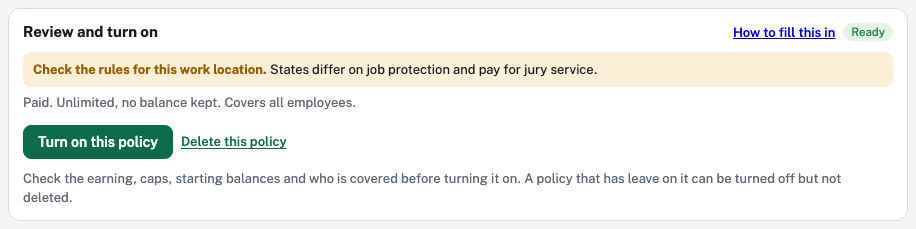
| Box | What it means | In this example |
|---|---|---|
| Ready, or "N to finish" | Ready means every required box is filled. "2 to finish" means two boxes marked Required are empty. | |
| Check the rules for this work location | Shown for sick, jury duty, parental, weather and custom policies. Local law can set rules for these. | |
| The summary sentence | The policy in one line, for example "Paid. 80 hours a year, spread over each paycheck". Read it before you turn the policy on. | |
| Turn on this policy / Turn off | Turns the policy on for the employees covered, or off. A new policy starts turned off. | |
| Delete this policy | Only while no leave has been recorded on it. After that you can turn it off but not delete it. |
Common questions
Must I pay an employee on jury duty?
Federal law does not require it for hourly (non-exempt) staff, but some states do. For exempt salaried staff, salary cannot be reduced for jury duty absences.
Can I ask for proof?
Yes, many companies ask for the summons. Say so in the Description for employees.
The U.S. Department of Labor says the FLSA does not require payment for time not worked, including jury duty, and that some state laws require employers to pay employees who serve. For exempt salaried employees, federal rules say an employer cannot make deductions from pay for absences caused by jury duty, but can offset jury fees the employee receives for that week.
Sources (government sites):